You Won’t Believe What This City Did to a Rusty Old Port
Walking through Bilbao, I couldn’t help but marvel at how a once-declining industrial city transformed itself into an architectural playground. It’s not just the famous titanium curves of the Guggenheim—Bilbao surprises at every turn, blending bold modern designs with historic charm. This is urban reinvention at its most creative, where steel mills gave way to statement buildings that draw visitors from across the globe. The city stands as a powerful example of how visionary design, cultural investment, and community-focused planning can breathe new life into places long written off by progress. Bilbao’s journey from industrial decay to architectural beacon offers inspiration for cities facing similar challenges.
From Smokestacks to Skylines
Bilbao, the largest city in Spain’s Basque Country, was once defined by its heavy industry. Throughout the 19th and much of the 20th century, it thrived as a center for shipbuilding, steel production, and manufacturing. The Nervión River, which cuts through the city, was lined with factories and warehouses, its waters busy with cargo ships ferrying raw materials and finished goods. However, by the 1980s, global industrial shifts and economic restructuring left Bilbao struggling. Factories closed, unemployment rose, and the city faced environmental degradation and urban decay. The port area, once a symbol of prosperity, became a neglected zone of rust and disuse.
The turning point came in the early 1990s, when city leaders sought a bold new vision to reverse the decline. Instead of pursuing traditional economic development models, they bet on culture and architecture as engines of renewal. The most pivotal decision was the construction of a museum that would not only house art but also serve as a landmark capable of attracting international attention. After extensive negotiations, the Solomon R. Guggenheim Foundation agreed to open a satellite museum in Bilbao, and the city seized the opportunity to redefine itself.
The selection of Frank Gehry as the architect proved to be a masterstroke. His radical, sculptural design broke from conventional museum architecture and announced Bilbao’s arrival on the global stage. But the Guggenheim was never meant to stand alone. It became the centerpiece of a broader urban regeneration strategy that included infrastructure upgrades, riverfront redevelopment, and the revitalization of surrounding neighborhoods. The transformation was not instantaneous, but over the following decades, the skyline of Bilbao evolved from one dominated by smokestacks to one defined by innovative forms and reflective surfaces.
This shift was more than aesthetic—it represented a fundamental reimagining of the city’s identity. Where Bilbao once measured its success in tons of steel produced, it now measures it in visitors welcomed, cultural events hosted, and quality of life improved. The industrial past is not erased but acknowledged, with remnants preserved as part of the city’s layered narrative. The transformation of Bilbao demonstrates that cities are not static; they can evolve, adapt, and reinvent themselves when guided by vision and collective will.
The Guggenheim Effect: More Than Just a Museum
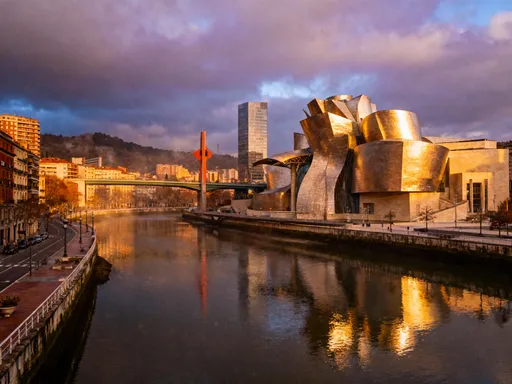
When the Guggenheim Museum Bilbao opened in 1997, it was immediately hailed as a masterpiece of contemporary architecture. Designed by Canadian-American architect Frank Gehry, the building features undulating titanium panels, glass curtain walls, and limestone blocks arranged in a composition that resembles a ship, a flower, or a futuristic sculpture, depending on the viewer’s perspective. Its dynamic form, set beside the Nervión River, creates a striking contrast with the surrounding hills and older buildings. The museum’s exterior alone became a tourist attraction, drawing photography enthusiasts, architecture students, and curious travelers from around the world.
But the Guggenheim’s impact extends far beyond its visual appeal. In the first three years after opening, it attracted over 4 million visitors, a figure that stunned even its most optimistic planners. Annual attendance has consistently remained above 1 million, a remarkable number for a city of Bilbao’s size. This influx of visitors revitalized the local economy, boosting hotels, restaurants, and retail businesses. More importantly, it shifted global perceptions of Bilbao from a fading industrial town to a destination of cultural significance.
The phenomenon became known as the “Bilbao Effect”—a term used in urban planning and cultural policy to describe how a single iconic building can catalyze economic and social transformation. Cities from Liverpool to Abu Dhabi have studied Bilbao’s model, hoping to replicate its success. However, what many overlook is that the museum’s success was not just about architecture; it was about timing, investment in infrastructure, and a coordinated strategy that placed culture at the heart of urban development.
The museum also elevated Bilbao’s status within Spain and Europe as a center for contemporary art. Its exhibitions have featured works by major international artists, including Richard Serra, whose monumental steel installation The Matter of Time was specifically created for the museum’s largest gallery. This long-term commission underscores the museum’s commitment to site-specific art and architectural harmony. The Guggenheim Bilbao is not merely a container for art; it is an active participant in the artistic experience, shaping how visitors move through and engage with the works inside.
Moreover, the museum has played a crucial role in fostering local pride. Residents who once associated their city with pollution and decline now see it as a place of innovation and beauty. School programs, community events, and public art initiatives linked to the museum have deepened civic engagement. The Guggenheim has become more than a tourist magnet—it is a symbol of what is possible when ambition meets thoughtful design.
Beyond the Bilbao Effect: Other Architectural Gems
While the Guggenheim Museum is the most famous example of Bilbao’s architectural renaissance, it is far from the only one. The city is home to a diverse collection of structures that showcase the work of some of the world’s leading architects. Each building contributes to a broader urban tapestry that balances innovation with context, spectacle with functionality.
One of the city’s older architectural highlights is the Arriaga Theatre, named after the Basque composer Juan Crisóstomo de Arriaga. Located in the heart of the city, this neoclassical building, completed in 1890, features a symmetrical façade, ornate ironwork, and a grand interior with red velvet seating and a painted ceiling. Its design reflects the influence of French opera houses, particularly the Palais Garnier in Paris. Despite its age, the theatre remains a vibrant cultural venue, hosting performances of opera, ballet, and classical music. Its preservation and continued use illustrate Bilbao’s respect for its historical heritage even as it embraces the future.
Another iconic structure is the Zubizuri Bridge, designed by renowned architect Santiago Calatrava and opened in 1997. Spanning the Nervión River, the bridge features a sleek, white arch and a pedestrian walkway paved with wooden slats. Its name, which means “white bridge” in Basque, reflects its minimalist aesthetic. While visually striking, the bridge has been the subject of debate due to its functional shortcomings. The original glass tiles on the walkway were replaced with wood after proving slippery, and the narrow path can become congested during peak hours. Nevertheless, the Zubizuri remains a beloved landmark, symbolizing the city’s willingness to experiment with bold design.
Equally influential, though less flashy, are the metro stations designed by British architect Norman Foster. Opened in 1995, the Bilbao Metro system is often cited as one of the most user-friendly and aesthetically pleasing in Europe. Foster’s stations feature translucent canopies shaped like shells, allowing natural light to flood underground platforms. The design prioritizes clarity, accessibility, and passenger comfort. The main station, San Mamés, connects directly to the city’s football stadium and serves as a hub for regional transit. The metro system exemplifies how infrastructure can be both efficient and beautiful, enhancing daily life while contributing to the city’s modern identity.
Old Meets New in the Casco Viejo
At the heart of Bilbao lies the Casco Viejo, or Old Town, a medieval district that dates back to the city’s founding in 1300. With its narrow cobblestone streets, centuries-old churches, and timber-framed buildings, the Casco Viejo offers a stark contrast to the futuristic forms found near the riverfront. Yet, rather than resisting change, this historic neighborhood has embraced subtle architectural interventions that honor the past while accommodating contemporary life.
Many of the old buildings in the Casco Viejo have been adaptively reused. Former merchant houses now house boutique shops, artisan cafes, and small art galleries. Some façades have been carefully restored to reveal original stonework, while interiors have been modernized with energy-efficient lighting, climate control, and open floor plans. These transformations demonstrate how heritage preservation can go hand in hand with functional renewal. The result is a living district that feels authentic, not like a museum piece frozen in time.
One notable example is the renovation of the Mercado de la Ribera, one of Europe’s largest indoor markets. Originally built in the 1920s and expanded over the decades, the market underwent a major upgrade in the 2010s to improve accessibility and ventilation while preserving its industrial character. Today, it remains a bustling hub where locals buy fresh produce, seafood, and regional specialties. The market’s survival and modernization reflect Bilbao’s commitment to maintaining community spaces even as the city evolves.
The dialogue between old and new is also evident in smaller architectural details. In some alleyways, discreet LED lighting highlights historic carvings, while modern signage blends with traditional materials. Public art installations, such as sculptures integrated into building façades, create moments of surprise and reflection. These thoughtful touches ensure that innovation does not overwhelm history but instead creates a layered, dynamic urban experience.
Innovative Urban Spaces Shaping Daily Life
The Abandoibarra district, located between the Guggenheim Museum and the city center, exemplifies Bilbao’s approach to modern urban planning. Once an industrial wasteland, this riverside area has been transformed into a mixed-use zone featuring offices, cultural institutions, residential buildings, and public parks. The redevelopment was guided by principles of sustainability, walkability, and social inclusivity, ensuring that the space serves both residents and visitors.
Central to the district’s design are its public plazas and pedestrian pathways. Plaza Euskadi, for instance, is a large open space often used for concerts, markets, and public gatherings. Its gently sloping terrain and integrated seating make it accessible and inviting. Nearby, the Doña Casilda Iturrizar Park was expanded and redesigned to include wetlands, walking trails, and children’s play areas. These green spaces provide much-needed respite from urban density and contribute to the city’s environmental resilience.
Walkability is a key feature of Bilbao’s urban strategy. Wide sidewalks, clearly marked crosswalks, and pedestrian-only zones encourage people to move through the city on foot. The network of riverside promenades allows uninterrupted strolls along the Nervión, connecting major landmarks and neighborhoods. This emphasis on human-scale design fosters social interaction and improves public health by promoting active lifestyles.
Accessibility has also been prioritized. Elevators and ramps have been integrated into hilly areas, and the metro system connects all major districts. Public transit is reliable, affordable, and widely used, reducing traffic congestion and air pollution. These improvements have made Bilbao one of the most livable medium-sized cities in Europe, demonstrating that thoughtful design can enhance everyday life for people of all ages and abilities.
Materials, Light, and Landscape: The Sensory Side of Design
Bilbao’s architecture is not only visually striking but also deeply responsive to its environment. Architects have carefully selected materials that reflect the region’s natural and industrial heritage. The titanium cladding of the Guggenheim, for example, changes color with the weather and time of day, shimmering silver in sunlight and turning gunmetal gray under clouds. This responsiveness creates a dynamic relationship between the building and its surroundings.
Other structures incorporate local stone, wood, and iron, grounding them in the Basque landscape. The use of glass in metro stations, office buildings, and cultural centers allows for transparency and connection to the outdoors. Even in winter, when rainfall is frequent, the interplay of light and reflection keeps the city feeling bright and open.
The integration of architecture with the Nervión River is another defining feature. Bridges, promenades, and waterfront plazas have reconnected the city to its waterway, which had long been obscured by industrial infrastructure. Today, the river is a central element of urban life, used for recreation, transportation, and aesthetic enjoyment. Boats glide past illuminated buildings at night, creating a serene atmosphere that draws both locals and tourists.
The surrounding hills also play a role in shaping the city’s architectural identity. Buildings are often positioned to frame views of Mount Artxanda or the surrounding mountains, creating visual corridors that link urban and natural landscapes. Cable cars and funiculars provide access to elevated viewpoints, reinforcing the connection between city and nature. This holistic approach to design ensures that Bilbao’s transformation is not just about buildings, but about creating a harmonious relationship between people, place, and environment.
Why Cities Worldwide Are Watching Bilbao
The story of Bilbao’s renewal has captured the attention of urban planners, policymakers, and architects around the world. The so-called “Bilbao Model” has become a reference point for cities seeking to revitalize post-industrial areas through cultural investment. However, replicating its success requires more than building a single iconic structure. Bilbao’s transformation was the result of a long-term, coordinated effort that included economic diversification, community engagement, and sustained public investment.
One of the key lessons is the importance of authenticity. While many cities have attempted to create their own “Guggenheim moment,” few have achieved the same impact because they focused only on spectacle without addressing deeper social and economic needs. Bilbao succeeded because it used architecture as a tool for broader urban improvement, not as an end in itself. The benefits of tourism were balanced with investments in housing, education, and public services, ensuring that renewal did not come at the expense of residents.
Another lesson is the value of collaboration. The transformation involved partnerships between local government, private investors, cultural institutions, and citizens. Public participation was encouraged through consultations, open forums, and inclusive planning processes. This collective approach fostered a sense of ownership and pride, making the changes more sustainable over time.
Today, Bilbao stands as a testament to the power of visionary thinking. It shows that even cities facing severe economic challenges can reinvent themselves through creativity, courage, and commitment. The rusted port is no longer a symbol of decline but a canvas for innovation. As more cities grapple with the legacies of industrialization and the demands of the 21st century, Bilbao offers a compelling blueprint for renewal—one that honors the past, embraces the present, and builds confidently toward the future. Its journey reminds us that with the right vision, even the most unlikely places can become sources of inspiration.